
Most teams building browser automation today face a fundamental question: should I rely on AI-powered agents or stick with traditional automation workflows? The answer isn't as simple as choosing one over the other; it depends on what you need to accomplish, the complexity of your tasks, and your long-term goals.
In this article, I’ll break down the core differences between AI agents and automation workflows, answer common questions like "Are AI agents better than Zapier?" and "When should I use agents versus workflows?" and help you understand how to make the right choice for your web automation projects.
What Is the Difference Between AI Agents and Automation?
The Core Distinction: Reasoning vs. Rigid Scripts
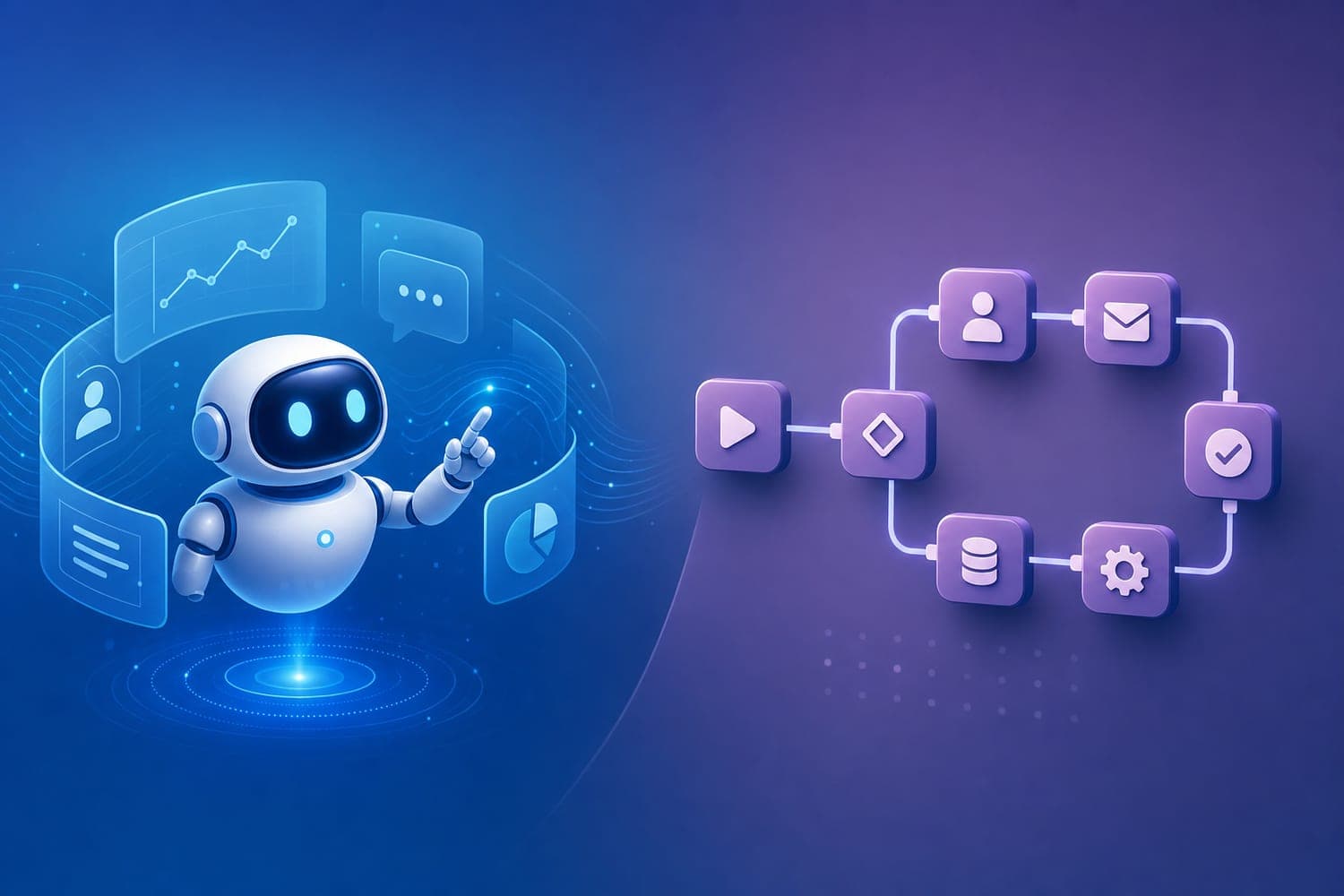
The fundamental difference lies in how they handle decision-making. Traditional automation follows a rigid "if-then" script—think of it as a train on tracks. It executes predefined steps without deviation. If an unexpected input appears, it often fails.
AI agents, on the other hand, are goal-oriented systems that reason. They interpret unstructured data, adapt to new situations, and figure out their own steps to reach a destination. Instead of following a fixed script, they use probabilistic reasoning to navigate complex tasks.
Supporting Points
| Aspect | Automation | AI Agents |
|---|---|---|
| Decision-making | Rule-based | Reasoning-based |
| Input handling | Structured data | Unstructured data (emails, audio) |
| Adaptability | Rigid | Self-correcting, pivoting |
| Architecture | Linear logic | Loops: Thought → Action → Observation |
Traditional automation is deterministic—perfect for high-volume, predictable tasks. AI agents are probabilistic, suitable for tasks involving judgment, ambiguity, or unstructured inputs.
When to Use Each
- Use automation workflows when tasks are repetitive, high-volume, and require strict consistency.
- Deploy AI agents when tasks involve unstructured data, require decision-making, or need to handle exceptions.
Are AI Agents Better Than Zapier?
The Short Answer
Not necessarily. AI agents and Zapier serve different purposes. Most teams find that a hybrid approach—using agents as the "brain" and Zapier as the "limbs"—works best.
Why Zapier Still Dominates for Certain Tasks
Zapier excels at structured, mission-critical workflows. It offers reliability, a vast app ecosystem, and predictable execution. For example, moving data from a form to a CRM or sending notifications—Zapier does this flawlessly.
When to Consider AI Agents
AI agents shine in tasks requiring judgment, such as reading a support email, understanding context, or making complex decisions. They can process messy inputs and adapt on the fly.
Practical Insight
Tools like Mark can combine the reasoning power of AI with the reliability of workflows, enabling you to automate complex, judgment-based tasks without sacrificing consistency.
When Should You Use Agents vs. Workflows?
The Decision Framework
| Use Case | Recommended Approach |
|---|---|
| Repetitive, high-volume tasks with structured inputs | Workflows (e.g., RPA, Zapier) |
| Tasks requiring judgment, unstructured data, or adaptation | AI Agents |
| Complex processes with multiple decision points | Hybrid: Agentic workflows |
The Hybrid Model
Most advanced automation strategies today involve a hybrid architecture. An AI agent interprets and makes decisions, then triggers deterministic workflows for execution. This approach combines the best of both worlds.
Practical Example
Imagine monitoring competitor websites for price changes. An AI agent can interpret webpage content, decide if a change is significant, and then trigger a workflow to update your internal dashboards. Instead of building a massive, brittle script, you use an agent to handle the reasoning and workflows for execution.
The Economics and Future of AI in Automation
Cost Considerations
Most traditional automation costs around $0.001 per transaction. AI agents, due to their complexity, can cost 50-500x more per transaction. However, they automate tasks previously impossible or too costly to do manually.
Market Trends
By 2026, Gartner predicts 40% of enterprise applications will include task-specific AI agents. The global market for agentic AI is projected to reach over $10 billion, reflecting a shift toward autonomous, reasoning systems.
The Trust Factor
Most enterprises are cautious. The "Trust Tax"—the decline in consumer trust in AI-generated content—remains a barrier. Governance, compliance, and oversight are critical, especially when deploying multi-agent systems.
Final Thoughts
Most teams building browser automation should consider a hybrid approach. Use workflows for reliability and AI agents for judgment. Tools like Airtop are making it easier to orchestrate these systems seamlessly.
If you're still stitching together multiple tools or manually handling complex tasks, try Mark. It can interpret your goals, reason about the best approach, and automate end-to-end workflows with minimal fuss.
Understanding the difference between AI agents and automation workflows is key to scaling your automation efforts effectively. The future belongs to systems that combine reasoning with execution—so start experimenting now.