

Automation is changing.
On one end sits traditional automation: scripts and workflows that execute the same steps every time. Most marketers are familiar with tools like Zapier. These tools are fast and cheap. The issue is that they break if a button is moved, a new dialog added, or something in the process changes.
On the other end sits the new wave of agentic systems, the ones built on Computer Use models and general-purpose agent loops. Marketers using tools like Claude or Codex have access to a language model to decide what to do at every step. These models adapt to change and handle ambiguity. They are also slow, expensive, and non-deterministic: the same input does not reliably produce the same output.
What is important for marketers to understand is that there is a third option: for a repetitive task, you only have to deal with the ambiguity once.
That is what deterministic AI means in practice. Reason once, at build time. Compile the result. Then run the compiled artifact after that, calling the model only where the work is genuinely variable.
What Deterministic AI Actually Means
Deterministic systems produce the same output from the same input, every time.
A language model deciding its next action on every run is not deterministic. If you've been working with Claude or Codex for a few months, you've already experienced this. Ask these tools the same question every day and you'll get a different answer every time. That variance is a feature when you are exploring something new. It is a defect when you are pulling the same report from the same dashboard every morning.
Deterministic AI does not mean removing the model. It means moving it. You use the model where judgment is required, and you use code everywhere else.
Amir, our CEO, put it this way on our Product Hunt launch:
We compile intent into code that runs like software, using LLMs only when needed. 1% of the cost, 10x faster, and the same result every time.
The benefits of deterministic AI are:
- Lower costs
- Reliable results
Why Agency Has Diminishing Returns
When an AI system has "agency," it can observe, decide, act, and reassess. It looks at a page, reasons about what it sees, picks an element, clicks it, observes the result, and reasons again.
Agency is genuinely powerful. It lets a system handle situations it has never seen. It is also not free: it costs time, it costs money, and it introduces variance.
Here is the part that changes the math:
The value of agency is highest the first time you do something, and lowest the hundredth time.
The first time you extract data from an unfamiliar site, agency is exactly what you want. Something has to explore, handle the unexpected, and ask when a requirement is ambiguous. Do we want every product or the top ten? What happens at pagination? Which of these three buttons is the real one?
Once those questions are answered, all of that machinery becomes overhead. You do not need the system to rediscover the answer every morning at 6am. You need it to execute the answer you already have.
This is the actual inefficiency in fully agentic automation: it treats every execution as if it were the first one. You are paying a language model to relearn the task, forever.
The alternative has a different shape. The expensive thinking happens once, when you build the agent. What ships is code, and running it costs a few cents.
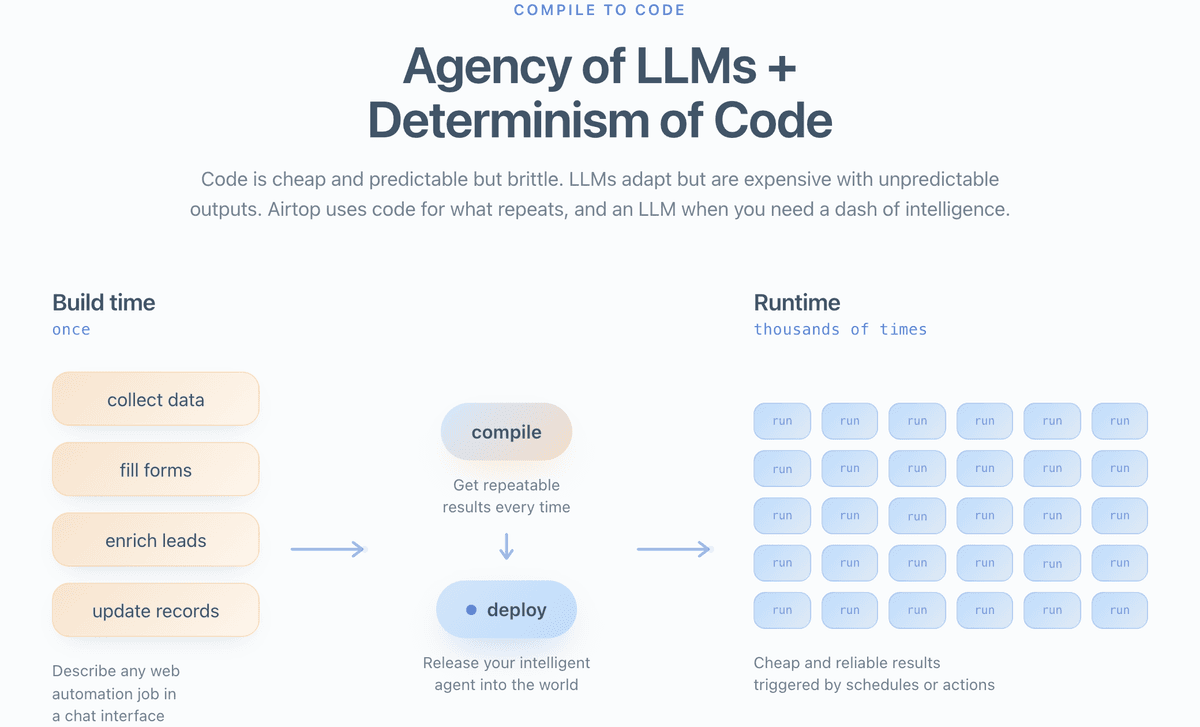
What Should Compile and What Stays a Model Call
A developer on our launch thread went straight to this important issue:
Compiling intent into code is the right instinct, we landed in the same place: re-deriving the same plan with an LLM on every run is what kills reliability. Where it got hard for us was the genuinely non-deterministic steps, like "is this reply a real lead or a bounce", you can't compile the judgment out.
He is right, and the answer is that we do not try to.
Compiling an agent means separating the parts of a task that are stable from the parts that are not.
Compiles to code. Navigation. Clicking. Typing. Scrolling. Uploading a file. The control flow between steps. These are stable. Once the builder has resolved "click the login button" into a specific, verified element, that step never needs a model again.
Stays a model call at runtime. Reading a page and answering a question about it. Extracting structured data across pages that change shape. Summarizing. Deciding whether a condition has been met. These are the judgment steps, and they call the model on every run, because they have to.
So the line falls exactly where the commenter drew it. "Is this reply a real lead or a bounce" is not compiled into fixed code. It stays a model call, forever, because it is a judgment. What gets compiled is everything around it: opening the inbox, finding the message, reading the field, writing the result to a sheet.
Amir's response:
You don't need to enumerate anything in advance, just describe the expected behavior. The idea is not to eliminate all usage of the LLM but to code the parts that are consistent and definitely do not require an LLM.
The agent builder makes the call, and you can steer it. If you tell the agent builder that a particular step needs model validation on every run, it will keep it there.
What Happens When the Site Changes
This was the second most common question on our launch. A compiled agent has an assumption baked into it about a page you do not control. A social media site reshapes its DOM. Vendors ship redesigns.
Three things happen, in order.
The actions heal themselves, up to a point. A compiled step does not hardcode a pixel coordinate. Airtop's browser actions carry a degree of self-healing, using a small amount of model inference to re-locate an element that moved or got renamed. Minor drift gets absorbed without a rebuild and without re-reasoning the whole workflow.
Monitoring catches the break. When an agent compiles, monitoring code is compiled alongside it. It verifies that each step actually completed before the next one starts. If a step fails, the agent retries. If it keeps failing, the agent stops and notifies a human, and one click opens it in the builder at the failing step.
Drastic changes need a rebuild. If a site redesigns the flow rather than moving a button, the agent tells you it broke and hands you the failure context. Rebuilding from that is fast, because the builder knows exactly which step stopped working and why.
That is a genuinely better failure mode than the two alternatives. A brittle script fails silently or crashes without explanation. A fully agentic system adapts, but you pay full model cost on every run forever to buy that adaptation, and you still cannot guarantee it adapts the same way twice.
What Compiling Does Not Fix
Another queston that came up from several commenters on our launch is variations of: "What about silent failures?"
The concern, in one commenter's words:
The happy path isn't the test, the silent drift is.
And another:
The loud failures are easy, the silent successes-that-aren't are the ones that erode trust.
A step completes. Nothing throws. The monitoring layer sees a green check. And the output is wrong: the form got filled with the right-looking value in the wrong field, or the classifier said "real lead" about a bounce with total confidence.
Compiling does not solve this, but neither does any other architecture.
The steps that fail loudly are the compiled ones. If a click fails because the button is gone, the step throws, monitoring catches it, you get told. That is the easy half, and compilation makes it easier by turning fuzzy runtime behavior into code that either runs or does not.
The steps that can be quietly wrong are the judgment steps, the ones that were never compiled, because judgment cannot be compiled. A model asked "is this a real lead" can be confidently wrong. It could be wrong in a fully agentic system too. Compiling neither causes that problem nor cures it.
What compiling does is shrink the surface area. In a fully agentic run, every step is a judgment call, so every step can be silently wrong. In a compiled agent, the deterministic steps are deterministic, and the only places silent wrongness can enter are the handful of steps that genuinely required a model. That is a much smaller surface area for unseen failures.
AI Agents vs Automation Workflows
With that in mind, the usual comparison gets clearer. The question is not really "AI agents or automation workflows." It is "where in this task does judgment actually live."
| Traditional automation | Fully agentic AI | Deterministic AI | |
|---|---|---|---|
| Decides at runtime | Never | Every step | Only the judgment steps |
| Same input, same output | Yes | No | Yes, for compiled steps |
| Cost per run | Very low | High, and scales with runs | Low, near-traditional |
| Handles a new site | No | Yes | Yes, at build time |
| Survives a small layout change | No | Yes | Yes, via self-healing actions |
| Survives a redesign | No | Usually | Rebuild, with failure context |
| Fails loudly | Sometimes | Rarely | Yes, on compiled steps |
Traditional automation, including RPA and the trigger-and-action platforms, is deterministic and cheap. It has no tolerance for change and no capacity for judgment. RPA fails on the DOM. Zapier cannot click a button on a website that never built an API.
Fully agentic AI is the opposite. It handles anything and guarantees nothing, and the cost compounds with every run.
Deterministic AI is a different decomposition of the same problem: use agency once, where the cost is worthwhile, then run code.
When to Use Which
Use a fully agentic system when you are exploring. One-off research. A task you will run twice. Anything where you do not yet know the shape of the work, and the model's ability to improvise is the whole point.
Use traditional automation when a clean API exists, the data is structured, and nothing about the environment will move.
Use deterministic AI when the task is repetitive, runs against a real website, and correctness matters. Lead enrichment every morning. Competitor pricing every hour. Pulling the same report from the same vendor portal that will never build an API. This is the case where paying a model to rediscover the task on every run is pure waste.
Amir said this on Product Hunt:
Coming with the GTM plan or strategy is something you can do with Claude. Actually automating your GTM in a reliable and cost-effective way is where Airtop shines.
Planning is a judgment task. Do it with a reasoning model. Execution is a repetition task. Compile it.
How Airtop Does This
You build an agent by describing what you want, in a conversation. The builder navigates the site in a live browser while you watch, asks when something is ambiguous, and writes the automation.
What ships at the end is generated code. It runs on our cloud browsers, with real browser fingerprints and residential IPs, so the sites it visits see a genuine browser session. It calls a model only for the steps that need one. It carries its own monitoring. When it breaks, it tells you.
On our own benchmark, a lead-generation task runs in 1 minute 21 seconds at $0.063. The same task, run by a general-purpose agent on Claude Opus, took 7 minutes 58 seconds and cost $6.26.
You can see how it works, or start building with Mark and watch it compile something.