
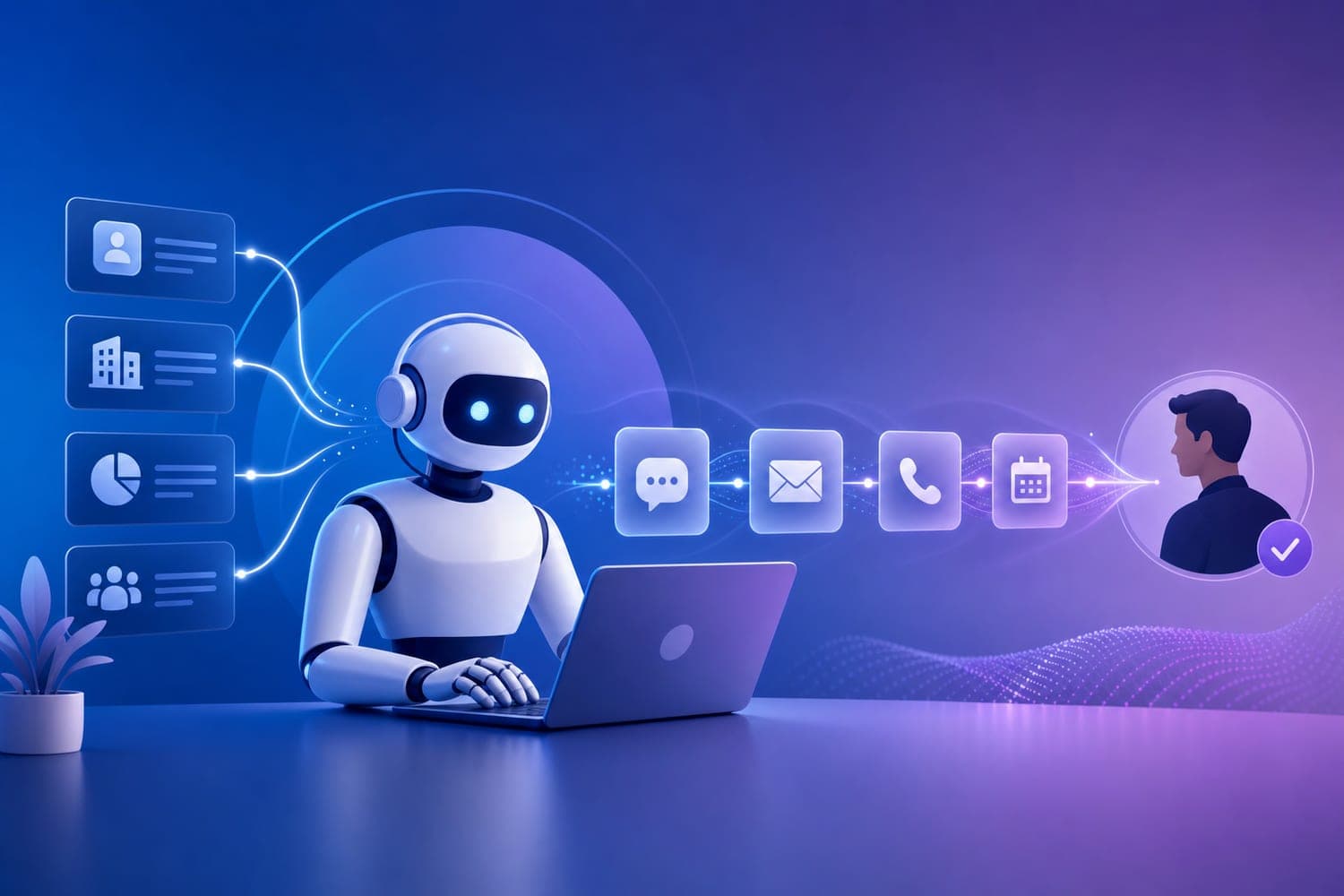
Understanding AI Sales Development Representatives (SDRs) is crucial as more sales teams adopt automation to scale their outreach. Most founders and Sales Ops teams ask: what exactly is an AI SDR, how do they work, and can we trust them to deliver results? In this article, I'll break down these questions with clarity and real-world insights.
What is an AI SDR?
An AI Sales Development Representative (AI SDR) is an autonomous software agent that uses artificial intelligence to automate the top-of-funnel tasks traditionally handled by human sales reps. These tasks include prospecting, lead qualification, initial outreach, and follow-up. Unlike basic automation, AI SDRs leverage natural language processing (NLP) and machine learning to perform context-aware research and generate hyper-personalized messages.
Most teams see AI SDRs not as replacements but as augmentations. They handle high-volume, repetitive activities—think thousands of outreach emails or LinkedIn messages—so human reps can focus on high-value, complex conversations. According to agilux.net, AI SDRs function as digital workers that absorb these repetitive tasks, increasing outbound capacity by 2-3x.
How do AI SDRs work?
AI SDRs operate through a multi-stage workflow that combines large language models (LLMs) like GPT-4 with data enrichment tools and workflow logic. Here's a typical process:
1. Targeting and Sourcing
The AI identifies prospects matching your Ideal Customer Profile (ICP) using integrated databases and intent signals. Instead of manually searching, tools like Thriwin or artemisgtm.ai automate this step.
2. Enrichment and Research
Next, the AI 'researches' each prospect by scraping data from LinkedIn, company websites, recent news, and funding announcements. This step ensures outreach is contextually relevant. As digitalapplied.com notes, success hinges heavily on data plumbing and routing—80-90% of the effort is in data integration.
3. Content Generation
Using LLMs, the AI crafts personalized outreach messages based on the research. Instead of static templates, it creates nuanced, tailored content that resonates with each prospect. This is where tools like autobound.ai excel, building sequences that adapt in real-time.
4. Engagement and Triage
The AI manages follow-up sequences, analyzes replies, and handles autonomous reply triage—booking meetings or flagging leads for human review. Currently, most teams keep a human gatekeeper for complex objections or high-stakes negotiations, as foxreach.io explains.
5. Multi-channel Orchestration
Modern AI SDRs coordinate across email, LinkedIn, SMS, and even AI-powered voice calls, creating a unified outreach thread. This multi-channel orchestration is critical for maintaining engagement and avoiding tool sprawl.
Are AI SDRs reliable?
Most teams find AI SDRs highly reliable for volume and consistency. They operate 24/7 without fatigue, follow up relentlessly, and can scale outreach efforts at a fraction of the cost of human SDRs—G2 reports platforms costing between $500 and $5,000 per month, reducing per-lead costs by up to 85%.
However, reliability in relationship-building and complex negotiations remains a challenge. AI lacks emotional intelligence and nuanced judgment, which are vital in high-stakes enterprise deals. As artemisgtm.ai highlights, deals sourced purely by AI show a 23% lower close rate for high-ACV contracts.
Most successful teams adopt a hybrid approach: AI handles high-volume outreach and scoring, while humans focus on final qualification and complex conversations. According to autobound.ai, hybrid AI-human teams achieve a 317% ROI with a 5.2-month payback period.
The Strategic Shift: From Replacement to Augmentation
Most sales leaders are shifting from viewing AI SDRs as replacements to seeing them as tools for augmentation. This shift addresses tool sprawl—many teams juggle 10-20 platforms—and helps consolidate workflows. Instead of stitching together multiple SaaS tools, try Mark to build and deploy AI-powered outreach in conversations.
The focus is on scaling pipeline without proportional headcount increases. As autobound projects, the market size for AI SDRs will reach $15 billion by 2030, driven by a 29.5% CAGR.
Final thoughts
AI SDRs are transforming the sales landscape. They excel at volume, consistency, and cost-efficiency but still fall short in nuanced relationship-building. The most effective teams blend AI automation with human judgment, creating a hybrid model that maximizes ROI.
If you're still managing outreach manually, tools like Mark can automate this entire workflow from a single conversation. As the technology matures, expect AI to handle more complex, multi-threaded negotiations—yet the human touch will remain essential for closing high-value deals.