
There's a fundamental tension in AI automation that doesn't get talked about enough.
On one end, you have traditional automation: scripts and workflows that execute the same steps every time (think RPA). They're fast and cheap, but they shatter the moment a website changes a button's location, adds a new dialog box, or even just updates code with no visible user changes.
On the other end, you have the new wave of "agentic" AI systems, including tools like Anthropic or Gemini's Computer Use models or OpenAI's Operator (now called Agents). These systems use powerful language models to decide what to do at every step. They can adapt to changes and handle ambiguity. But they're slow, expensive, and (perhaps most problematically) unpredictable.
Most discussions frame this as a binary choice. Either you get reliability without flexibility, or flexibility without reliability. But there's a third path that recognizes something important: for repetitive tasks, you only need to figure out how to do something once.
What "Agency" Actually Means
Before diving deeper, let's clarify what "agency" means in the context of AI systems.
When we say an AI has "agency," we mean it has the ability to make decisions, take actions, and adapt its behavior based on what it observes. A highly agentic system looks at a webpage, reasons about what it sees, decides what to click, observes the result, and then reasons again about what to do next.
This is fundamentally different from a script that says "click the button at coordinates (450, 320)" or even "click the element with ID 'submit-button'." The agentic system is thinking at every step. The script is just executing.
Agency is powerful. It lets AI systems handle situations they've never seen before, recover from unexpected states, and adapt to variations in how websites look or behave. But agency isn't free. It costs time, money, and introduces variability into outcomes.
The Two Extremes
Traditional Automation: Deterministic but Fragile
Traditional automation tools (think Zapier workflows, Selenium scripts, or recorded macros) operate on a simple principle: do exactly what you're told, in exactly the order you're told to do it.
The advantages are obvious:
- Fast execution: No thinking required, just clicking and typing
- Predictable results: The same inputs produce the same outputs every time
- Low cost: No expensive API calls to language models
But the disadvantages are equally obvious:
- Brittleness: When a website changes, even slightly, the automation breaks
- High maintenance: Someone technical needs to update the scripts regularly
- Limited capability: Can only handle situations that were explicitly programmed
For many businesses, this trade-off was acceptable when websites were relatively static. But modern web applications change constantly. A/B tests shift button positions. New features add pop-ups and modals. Login flows get updated. Each change is a potential breaking point.
Fully Agentic Systems: Flexible but Costly
The newest generation of AI automation takes the opposite approach. Systems like Anthropic's Computer Use, OpenAI's Operator, and similar tools use large language models to control computers the way a human would: by looking at the screen, reasoning about what they see, and deciding what to do.
The advantages are compelling:
- Adaptability: Can handle websites they've never seen before
- Self-correction: If something goes wrong, they can notice and recover
- No maintenance: Don't break when websites change
But this flexibility comes at a steep price:
- Speed: Every action requires a call to a powerful (and slow) language model
- Cost: Those API calls add up fast, especially for tasks that run frequently
- Unpredictability: An AI that thinks for itself might not always think the same way twice. Even the state of the art computer use models experience randomness, producing unexpected or incorrect behavior between 20% to 60% of the time (depending on complexity)
That last point deserves emphasis. When you give an AI agent the freedom to make decisions, it will sometimes make different decisions in similar situations. For a task that requires consistent, reliable execution (like pulling the same data from the same source every day) this variability is a bug, not a feature.
Consider a concrete example: extracting the top products from Product Hunt every morning. With a fully agentic system, every single execution involves the AI looking at the page, reasoning about where the products are listed, figuring out how to scroll to see more, deciding what information to extract, and so on. That's a lot of thinking for a task that's fundamentally the same every day. And with non-deterministic systems, if you do a task 1000 times per day, even a small probability of error compounds, leading to a large number of attemps ending in failure.
You're paying for the AI to re-learn the task every time it runs.
The Hidden Insight: Agency Has Diminishing Returns for Repetitive Tasks

Here's the insight that changes the equation: the value of agency is highest the first time you do something, and lowest the hundredth time.
When you're figuring out how to extract data from a new website, agency is invaluable. You need an AI that can explore, make decisions, handle unexpected situations, and ask clarifying questions when something is ambiguous. Should we get all the products or just the top 10? What fields matter? How do we handle pagination?
But once you've answered those questions and established a working approach, all that agency becomes overhead. You don't need the AI to re-figure-out the answer every single time. You need it to reliably execute what you've already established works.
This is the fundamental inefficiency in fully agentic systems for repetitive automation: they treat every execution as if it were the first time, even when the task is well-understood.
A Different Approach: Front-Loading Intelligence
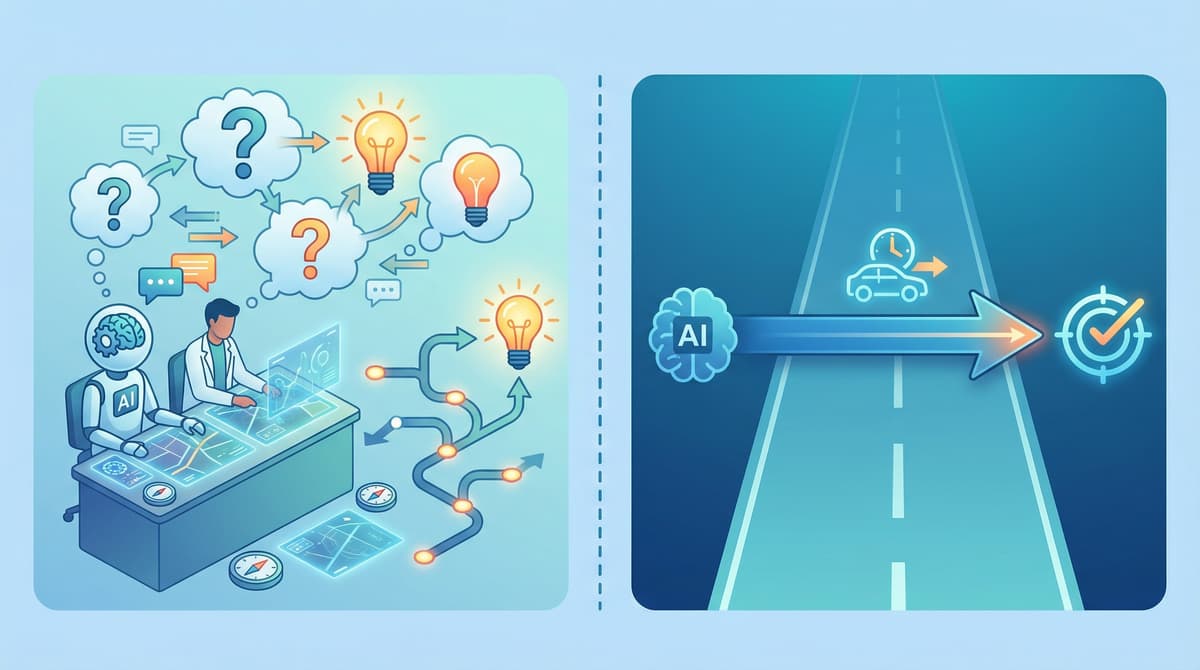
What if you could get the benefits of agency when you need them (during the setup and configuration phase) while capturing the speed and reliability of deterministic execution when the task actually runs?
This is the core idea behind what we might call "build-time agency." The concept is straightforward:
- During setup, use a powerful, capable AI system that can explore, reason, adapt, and learn. Let it take screenshots, make decisions, ask clarifying questions, and figure out the best way to accomplish the task.
- During execution, run a much more deterministic agent that was generated during setup. Use AI sparingly for things like finding elements that might have moved slightly, or extracting meaning from text, but not for decision-making at every step.
The key insight is that setup happens once, but execution happens over and over. By concentrating the expensive, slow, agentic behavior at setup time, you pay that cost only once. Then you get fast, cheap, reliable execution every time the task actually runs.
How This Works in Practice
Let's return to our Product Hunt example. With a build-time agency approach:
During setup:
- A capable AI assistant navigates to Product Hunt, observing the page and understanding its structure
- It identifies where the products are listed, how to access additional information, and how pagination works
- If anything is ambiguous (like whether to include products from sponsors or just organic listings) it asks for clarification
- It might make mistakes along the way, but it can observe those mistakes and correct course
- This process takes time and uses significant AI resources, but it only happens once
During execution:
- The generated agent runs and knows exactly where to look and what to extract
- AI is used tactically to locate elements that might have shifted position, or to interpret text, but not to make strategic decisions
- Execution is fast and cheap (minimal AI usage)
- The same agent produces consistent results every time
The result is an agent that has all the adaptability benefits of agentic setup (it understood the page, handled ambiguity, and established a working approach) but all the reliability benefits of deterministic execution.
The Airtop Approach
At Airtop, we've built our entire platform around this philosophy.
When you create an agent with Airtop, you work alongside our AI assistant in a conversational interface. You can see exactly what the AI is doing in a live browser view as it explores the website and figures out how to accomplish your task. If the AI gets confused or encounters ambiguity, it asks you rather than guessing and hoping for the best.
Once the agent is built, what actually executes is generated code: deterministic, fast, and consistent. The result is an agent that runs quickly, costs a fraction of fully agentic execution, and produces reliable results day after day.
Choosing the Right Tool for the Job
The AI agent landscape is evolving rapidly, and there's no single right answer for every situation. But understanding the agency spectrum helps you make better decisions:
- For exploring new, unknown territory: High runtime agency makes sense. You need the AI to think on its feet.
- For reliable, repetitive execution: Build-time agency offers the best combination of capability and reliability.
For repetitive tasks, the build-time agency approach delivers concrete advantages:
- Lower costs: AI usage is front-loaded to setup, not multiplied across every execution
- Faster execution: Deterministic agents run quickly
- More consistent results: Less room for the AI to make different decisions each time
- Human oversight where it matters: Clarifying questions during setup catch misunderstandings before they become repeated errors
The mistake is treating "more agency" as uniformly better. Agency is a tool with costs and benefits. The question isn't whether to use it, but when to use it. For repetitive agents—the kind that businesses rely on to run operations, gather data, and execute tasks—front-loading that agency to build time isn't a compromise. It's simply the smarter approach.
Ready to build reliable AI agents? Try Airtop free and see how build-time intelligence creates better agents.